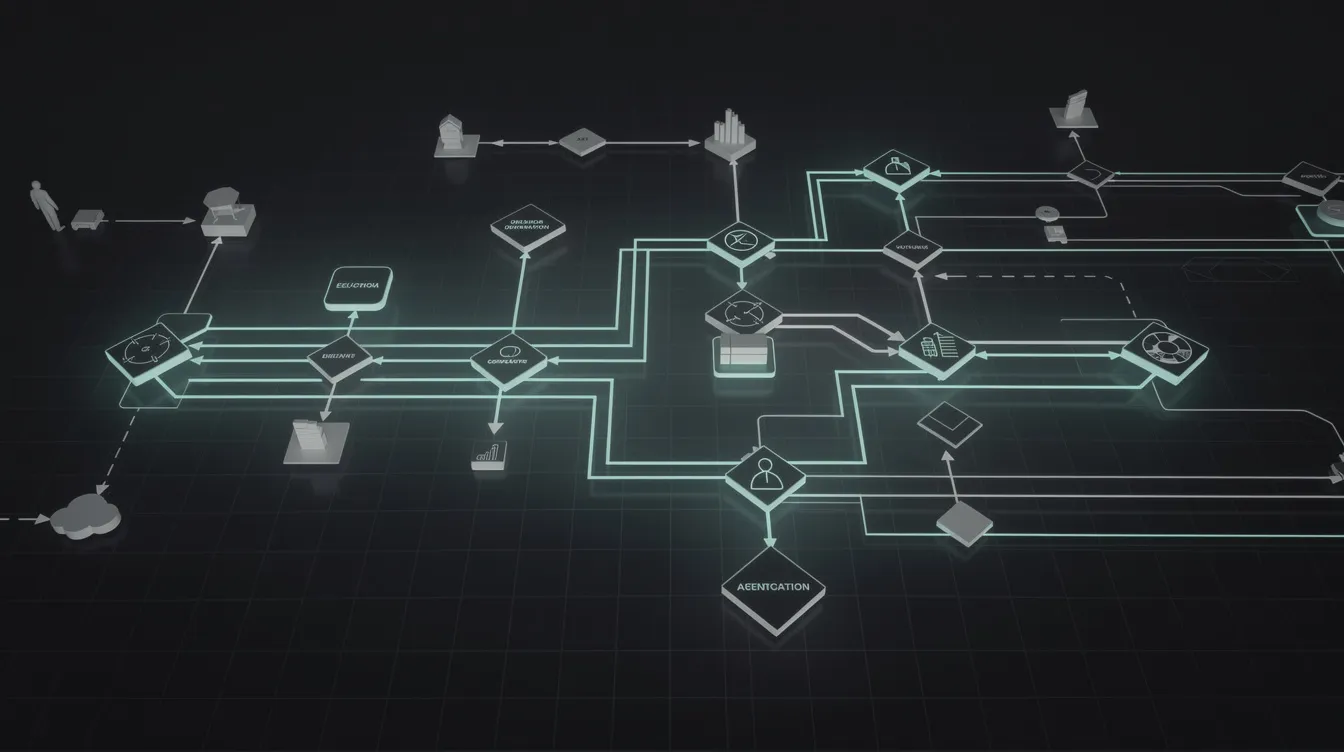
The term "AI-native company" gets used loosely. In most contexts, it refers to a business that was designed from its earliest stages to use AI systems as core operational infrastructure rather than bolting them on after the fact. But what does that actually look like at the stack level?
For founders evaluating whether to build on an AI-native foundation, the answer matters. The stack you choose at formation shapes everything downstream: how you handle compliance, how your workflows scale, and whether your operating costs stay manageable as you grow.
What the AI-native company stack actually includes
A useful way to think about the stack is in four layers, each representing a phase of company lifecycle operations.
Layer 1: Formation and entity setup
This is the most mature layer. Services like Stripe Atlas, Firstbase, and Clerky already automate large parts of incorporation, EIN assignment, registered agent setup, and initial banking. What makes this layer "AI-native" is not that the process itself is AI-driven — it is that the formation data flows directly into downstream operational systems without manual re-entry.
An AI-native formation layer connects incorporation outputs (entity type, jurisdiction, ownership structure) to the next layers automatically. The AI-Native Company Formation & Operations Platform opportunity explores how a unified platform could own this entire pipeline.
Layer 2: Financial and compliance operations
Once a company exists as a legal entity, it needs banking, bookkeeping, tax preparation, and ongoing compliance management. Traditional approaches require a founder to stitch together a bank account, an accounting tool, a payroll provider, and a tax advisor — each operating independently.
In an AI-native stack, these functions share a data layer. An AI agent can categorize transactions as they arrive, flag compliance deadlines, and prepare draft filings for human review. The key constraint is trust: financial operations require auditability, so AI agents in this layer need clear oversight mechanisms and human approval gates.
The AI Company Formation Stack Directory concept addresses the discovery problem here — helping founders evaluate which tools in this layer are worth integrating.
Layer 3: Workflow automation and back-office operations
This is where most of the current excitement (and most of the unproven claims) live. Back-office operations include HR administration, contract management, vendor coordination, internal communications, and reporting. Each of these functions involves repetitive, rule-based work that is theoretically automatable.
In practice, the state of the art is narrower than the marketing suggests. AI agents today handle specific, well-scoped tasks effectively: drafting routine communications, extracting data from documents, scheduling follow-ups, and flagging anomalies in financial data. They struggle with tasks that require judgment across multiple contexts, tasks with high ambiguity, and tasks where errors carry significant downstream cost.
A credible AI-native stack at this layer uses agents for routine execution under human oversight, not for autonomous decision-making. The distinction matters because it shapes how you architect the system and what you promise customers.
Layer 4: Intelligence and decision support
The top layer is the least developed but arguably the most valuable long-term. This is where operational data flows back into analysis: revenue trends, cost patterns, compliance risk signals, market positioning data.
An AI-native company at this layer uses its own operational data to generate insights that inform strategy. Think of it as a continuously updating operating dashboard where the AI does not just display metrics but surfaces patterns, flags risks, and proposes adjustments.
This layer is mostly aspirational today. A few vertical-specific platforms offer elements of it, but no one has built a general-purpose intelligence layer for small and mid-size company operations. The opportunity is large but requires the lower layers to be stable first.
Where the stack breaks down
The biggest gap in the current AI-native company stack is integration. Each layer has capable point solutions, but they do not talk to each other well.
Formation tools output PDFs and confirmation emails. Banking tools have their own dashboards. Accounting tools require manual CSV imports. HR platforms operate in silos. The "stack" is really a collection of disconnected services that a founder manually coordinates.
This is exactly the problem that a platform approach could solve. As noted in a 2025 analysis by Bessemer Venture Partners, "the next wave of B2B infrastructure will be defined by companies that own the data layer across multiple operational functions, not by companies that optimize a single function in isolation."
The founders who understand this structural gap are the ones best positioned to build on — or acquire — the infrastructure that closes it.
What founders should evaluate
Before committing to an AI-native stack, founders should ask five questions:
- Does the formation layer connect to downstream operations? If you have to re-enter entity data manually, you are not building on an AI-native foundation.
- Are the AI agents scoped to tasks where errors are recoverable? Autonomous bookkeeping is different from autonomous tax filing. Know where the oversight gates are.
- Is the data portable? If your stack vendor locks you in, your operational flexibility decreases as you scale. Open data formats and API access matter.
- What is the real automation rate? Ask vendors what percentage of tasks their AI agents complete without human intervention, and what percentage require review. The honest answer is usually lower than the marketing number.
- Does the pricing model scale with your usage? Per-seat pricing on a workflow automation tool can become expensive fast. Understand the cost curve before you commit.
The category is forming now
The AI-native company stack is not a finished product category. It is an emerging infrastructure layer that is still being defined. The tools exist in pieces, the integration layer is thin, and the intelligence layer is mostly theoretical.
But the trajectory is clear. Every quarter, the formation layer gets more automated, the financial operations layer gets more AI-assisted, and the workflow automation layer gets more capable. Founders who understand the full stack — its strengths and its current limitations — will make better infrastructure decisions than those who adopt tools based on marketing alone.
The question is not whether AI-native company stacks will become standard. It is who will define the category and own the integration layer. That is an infrastructure problem, a naming problem, and a market timing problem — all at once.