The term "agentic workflow" has entered the business technology lexicon with the usual mix of genuine capability and inflated expectations. For operators trying to make practical decisions about where to deploy AI agents in their business operations, the noise-to-signal ratio is unfavorable.
This analysis cuts through the positioning to answer a direct question: where do AI agents actually work in business operations today, and where do they fall short?
Defining the scope
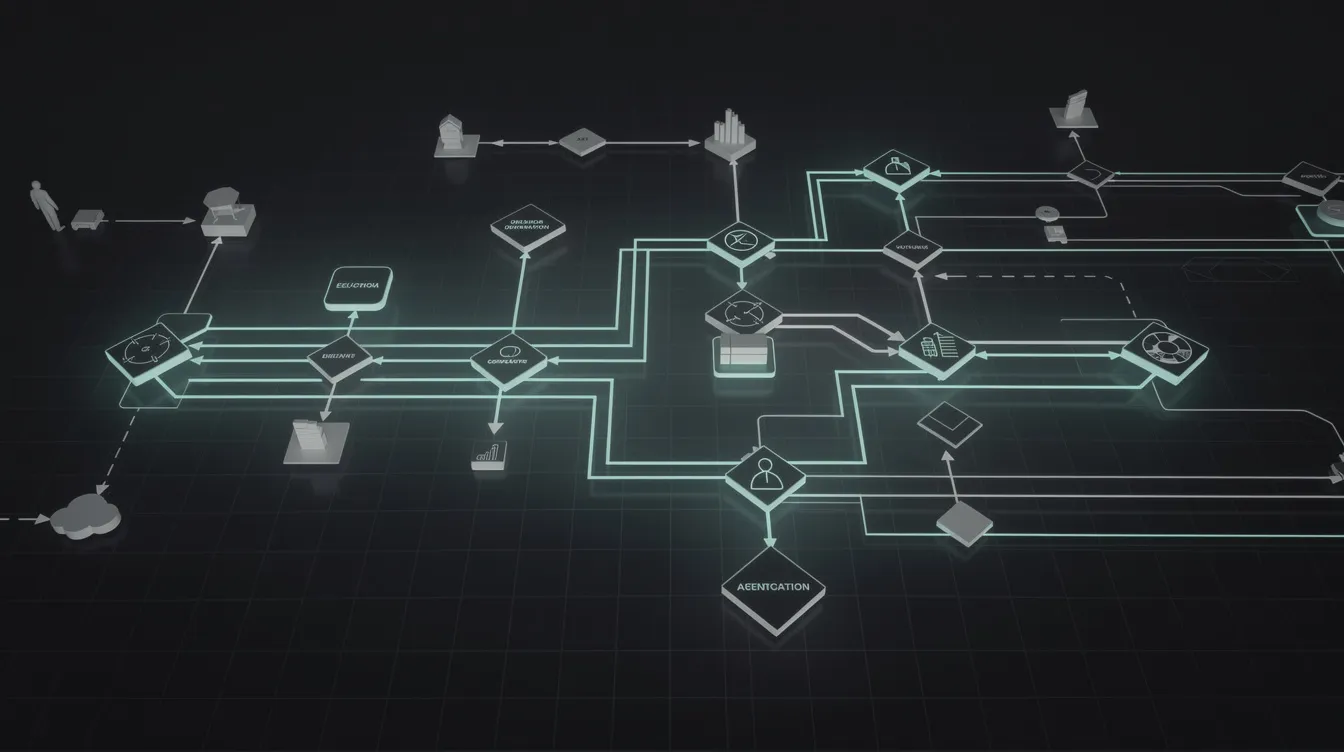
An agentic workflow, in the operational context, is a process where an AI agent executes a sequence of tasks with minimal human intervention. The agent receives an input (a document, a data event, a scheduled trigger), performs one or more actions (classification, extraction, generation, routing), and produces an output that either completes the workflow or passes it to the next step.
The critical distinction is between assisted workflows (where the AI helps a human complete a task faster) and autonomous workflows (where the AI completes the task independently). Most of what works today falls into the first category, with a few notable exceptions.
What works today
Financial transaction categorization
This is one of the most mature agentic workflow applications. AI agents can categorize business expenses, match transactions to invoices, and flag anomalies with accuracy rates above 90% for businesses with consistent spending patterns.
The practical implementation involves an agent that monitors bank feeds, applies categorization rules learned from historical data, and presents categorized transactions for human review. The human approval step takes seconds per transaction instead of minutes, reducing bookkeeping time by 60-70% for a typical small business.
Constraint: Accuracy degrades for businesses with highly variable expenses, international transactions in multiple currencies, or complex multi-entity structures. Human review remains essential for edge cases.
Document processing and data extraction
AI agents are effective at extracting structured data from semi-structured documents: invoices, receipts, contracts, and forms. Modern document AI can identify key fields (amounts, dates, parties, terms) and populate structured records without manual data entry.
This capability is particularly valuable for accounts payable workflows, where incoming invoices need to be matched to purchase orders, coded to the correct expense category, and queued for approval. An agent handling this workflow can process routine invoices end-to-end with human review only at the approval stage.
Constraint: Handwritten documents, poor-quality scans, and non-standard formats still cause errors. The agent needs a fallback path to human processing for documents it cannot parse with high confidence.
Compliance monitoring and deadline management
AI agents can monitor regulatory calendars, cross-reference them with company-specific obligations, and generate reminders and draft filings. This is particularly useful for businesses operating across multiple jurisdictions, where the compliance surface area grows with each state or country.
The workflow typically involves an agent that maintains a compliance calendar, monitors for regulatory updates, and generates task lists with deadlines, required documents, and draft submissions. The human reviews the draft, approves or modifies it, and submits.
Constraint: Regulatory interpretation is not fully automatable. The agent can track deadlines and prepare drafts, but a human with domain knowledge needs to verify that the interpretation is correct, especially for novel situations or ambiguous regulations.
Customer communication drafting
AI agents can draft routine customer communications — order confirmations, status updates, follow-up sequences, FAQ responses — with quality sufficient for human review and send. The agent uses customer data, order history, and communication templates to generate contextually appropriate messages.
For businesses with high communication volume (e-commerce, SaaS, professional services), this capability reduces response time and frees team members for complex interactions that require human judgment.
Constraint: Tone management across sensitive situations (complaints, refund disputes, legal matters) still requires human handling. The agent should be configured to escalate rather than attempt to resolve emotionally charged interactions.
What does not work yet
Autonomous financial decision-making
Despite marketing claims, AI agents are not ready to make financial decisions autonomously in most business contexts. Approving expenditures, making investment allocations, or adjusting pricing require judgment that accounts for context an agent cannot fully access: competitive dynamics, relationship considerations, strategic priorities, and risk tolerance.
The Agentic Back-Office Operations Platform opportunity recognizes this constraint directly. Its architecture positions AI agents as executors of routine operations under human oversight, not as autonomous decision-makers. This is not a limitation of vision — it is a realistic assessment of where trust boundaries sit today.
Complex contract negotiation
AI agents can draft standard contracts and flag deviations from templates, but they cannot negotiate complex agreements. Negotiation requires understanding the other party's priorities, reading implicit signals, making strategic concessions, and managing relationship dynamics that extend beyond the specific contract.
Contract AI is useful for preparation and review. It is not useful for negotiation itself.
Cross-functional process orchestration
Orchestrating processes that span multiple business functions (finance, HR, operations, legal) remains largely manual. The challenge is not that individual agents cannot handle their respective tasks — it is that there is no reliable integration layer connecting them.
A payroll change triggers tax implications, which trigger compliance requirements, which may trigger employment law considerations. Today, a human coordinates this cascade. The integration infrastructure to automate it does not exist at the small and mid-size business level.
Judgment under ambiguity
Any workflow that requires resolving ambiguity — interpreting unclear customer requests, making personnel decisions, evaluating strategic trade-offs — remains firmly in human territory. AI agents can present options and surface relevant data, but the judgment call stays with a person.
The practical deployment framework
For operators considering where to deploy agentic workflows, a straightforward framework applies:
High confidence (deploy now):
- Transaction categorization and reconciliation
- Document data extraction for structured document types
- Compliance deadline tracking and reminder generation
- Routine communication drafting with human review
Medium confidence (pilot carefully):
- Invoice processing end-to-end with approval gates
- Report generation from structured data sources
- Meeting scheduling and calendar coordination
- Basic HR document generation (offer letters, policy acknowledgments)
Low confidence (wait or supervise heavily):
- Financial decision support beyond data presentation
- Contract review for non-standard agreements
- Cross-functional workflow orchestration
- Any process with high cost of error and low reversibility
The infrastructure gap
The practical challenge for most operators is not selecting the right agent for a task. It is connecting the agent to the right data sources and output channels.
Most business AI tools operate in isolation. The bookkeeping agent does not share context with the compliance agent. The document processing agent does not update the financial system automatically. Each tool requires its own integration, its own data mapping, and its own oversight configuration.
This is why the platform opportunity is significant. As explored in the Instant Company Readiness Checker, understanding your current tool stack and identifying integration gaps is a practical first step toward deploying agentic workflows effectively.
The operators who will benefit most from agentic workflows in 2026 are not the ones with the most advanced AI tools. They are the ones with the cleanest data, the most structured processes, and the clearest understanding of where human judgment is required versus where routine execution can be delegated.
Looking ahead
The capability frontier for agentic workflows is advancing quarterly. Tasks that required heavy human oversight six months ago now run with light-touch review. The accuracy rates improve, the integration options expand, and the cost per automated task decreases.
But the fundamental architecture question remains: who builds the orchestration layer that connects these individual capabilities into coherent operational systems? That is not an AI problem. It is an infrastructure problem, a data problem, and a trust problem — all of which need to be solved together.